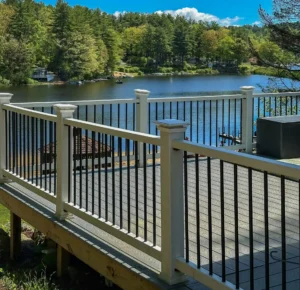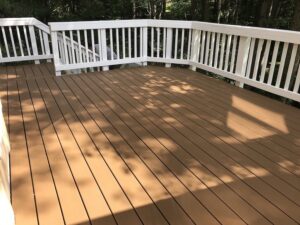
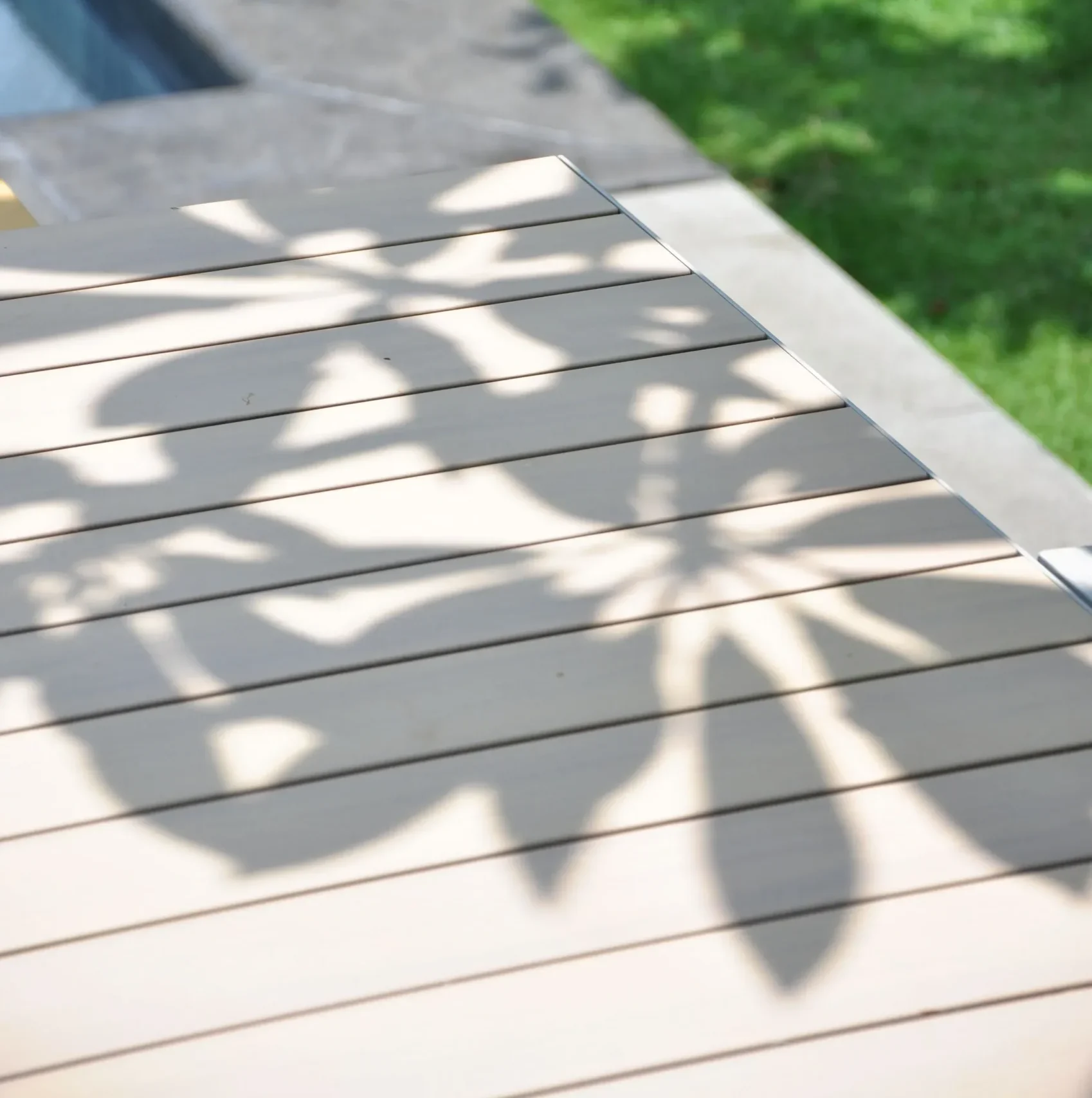
Your deck should be more than a place to put a grill, it should be a comfortable, inviting extension of your home. At DeckGuru, we help Northern Virginia homeowners transform worn, outdated decks into beautiful outdoor spaces they can enjoy again.
Whether your existing deck needs a refresh or you’re ready for a major upgrade, our team takes a restoration-first approach to find the right solution without automatically recommending a costly tear-down.
From composite decking and resurfacing to railing upgrades and wood replacement, we can help bring your vision to life. Ready to give your deck a new look? Contact DeckGuru or call 866-814-8188 to schedule your estimate.
Composite vs. PVC Decking: What’s the Difference?
The primary difference between composite decking vs PVC is what the boards are made from.
Composite decking is generally manufactured using a combination of wood fibers and plastic polymers. Many modern composite boards also feature a protective polymer shell designed to improve resistance to moisture, stains, fading, and other forms of outdoor wear.
PVC decking is made entirely from polyvinyl chloride, a synthetic plastic material. Because it doesn’t contain wood fibers, PVC is highly resistant to moisture and doesn’t have the same organic components that can contribute to rot or decay.
Both are considered manufactured decking materials, but they offer somewhat different characteristics.
| Feature | Composite Decking | PVC Decking |
| Main material | Wood fibers + polymers | PVC plastic |
| Wood-like appearance | Excellent | Excellent with quality products |
| Maintenance | Low | Very low |
| Moisture resistance | Excellent with capped products | Excellent |
| Rot resistance | Excellent | Excellent |
| Insect resistance | Excellent | Excellent |
| Upfront cost | Generally moderate | Generally higher |
| Weight | Heavier than PVC | Lightweight |
| Natural feel | More wood-like | More synthetic |
| Best for | Balanced performance and value | Maximum moisture resistance and low maintenance |
The exact characteristics can vary considerably between manufacturers and product lines, so it’s important to compare the specifications of the specific boards you’re considering. TimberTech’s comparison of PVC vs. composite decking similarly notes that both materials offer low maintenance and durability, while PVC generally has greater water resistance and composite can have a lower upfront cost.
What Is Composite Decking?
Composite decking combines wood fibers and plastic to create a decking material designed to provide the appearance of wood with less maintenance.
Modern composite decking has evolved significantly from some of the earliest products on the market. Many premium boards now feature protective outer shells that help defend the material against moisture, staining, fading, scratching, and mold.
Benefits of Composite Decking
There are several reasons composite decking has become a popular choice for homeowners.
Benefits include:
- Low maintenance
- No routine staining or sealing
- Resistance to rot
- Resistance to insects
- Reduced risk of splintering
- Numerous colors and textures
- Wood-inspired grain patterns
- Long-lasting performance
- Compatibility with a variety of deck designs
DeckGuru’s composite decking guide explains that composite materials can withstand Northern Virginia weather while requiring significantly less maintenance than traditional wood.
Composite decking is also a strong option for homeowners who want the appearance of a wood deck without spending their weekends sanding, staining, and sealing the surface.
What Is PVC Decking?
PVC decking is made entirely from synthetic plastic rather than a combination of wood fibers and plastic.
Because PVC contains no organic wood material, it doesn’t absorb moisture in the same way traditional wood does. This makes PVC particularly appealing in areas where water exposure is a major concern.
Modern PVC products can also mimic the appearance of natural wood with realistic colors, grain patterns, and textures. Older PVC decking sometimes developed a reputation for looking overly synthetic, but manufacturers have continued to improve the appearance of newer products.
Benefits of PVC Decking
Some of the primary benefits of PVC decking include:
- Excellent moisture resistance
- Resistance to rot
- Resistance to insects
- Very low maintenance
- Lightweight construction
- No routine staining or sealing
- Wide variety of colors and designs
- Long service life with appropriate installation and care
PVC can be particularly attractive for homeowners who prioritize moisture resistance and want a decking material that requires very little ongoing maintenance.
However, quality varies between products. Homeowners should evaluate the manufacturer’s specifications, warranty, heat performance, slip resistance, appearance, and installation requirements before choosing a PVC product.

Composite vs. PVC Decking: Which Lasts Longer?
When comparing composite vs PVC decking, lifespan is one of the biggest considerations.
Both materials can provide long-term performance when they are properly installed and maintained.
Some premium PVC decking products are designed for service lives of 50 years or more. Composite decking can also last for decades, with product warranties varying by manufacturer and product line.
For example, TimberTech currently describes its Advanced PVC decking as having a 50+ year lifespan while describing its composite decking as having a 25–30+ year lifespan. These figures are manufacturer-specific rather than guarantees that apply to every product on the market.
Trex likewise offers multiple decking lines with different warranty periods, demonstrating why homeowners should evaluate the specific product rather than assuming all composite or PVC decking has the same lifespan.
The quality of the installation and the conditions surrounding the deck also matter.
Composite vs. PVC Decking: Which Is More Durable?
Both composite decking and PVC decking are designed to withstand outdoor exposure better than traditional untreated wood.
Composite decking is resistant to many common wood-deck problems, including:
- Rot
- Insect damage
- Splintering
- Warping
- Moisture-related deterioration
PVC has an additional advantage in that it contains no wood fibers. As a result, moisture absorption isn’t a concern in the same way it can be with materials containing organic components.
However, durability isn’t just about the board material.
The deck’s underlying framing, joists, fasteners, drainage, ventilation, and installation all contribute to how well the finished deck performs.
That’s one reason DeckGuru evaluates the existing structure before completing a composite deck upgrade.
Composite vs. PVC Decking: Which Requires Less Maintenance?
If low-maintenance living is your priority, both materials are excellent alternatives to wood.
Traditional wood decks typically require periodic cleaning, staining, sealing, and repairs. Composite and PVC decking eliminate much of that work.
DeckGuru’s guide to cleaning composite decking recommends regular cleaning to remove leaves, dirt, pollen, and other debris. The company notes that composite decking is not completely maintenance-free, even though it requires significantly less upkeep than traditional wood.
PVC decking also requires routine cleaning to keep dirt and organic debris from accumulating.
For either material, basic maintenance may include:
- Sweeping debris from the surface
- Cleaning spills promptly
- Washing the deck periodically
- Removing leaves and organic debris
- Following the manufacturer’s cleaning instructions
- Inspecting the deck structure regularly
The goal isn’t to eliminate maintenance completely. It’s to make routine deck care easier and less time-consuming.
Composite vs. PVC Decking: Which Looks More Like Real Wood?
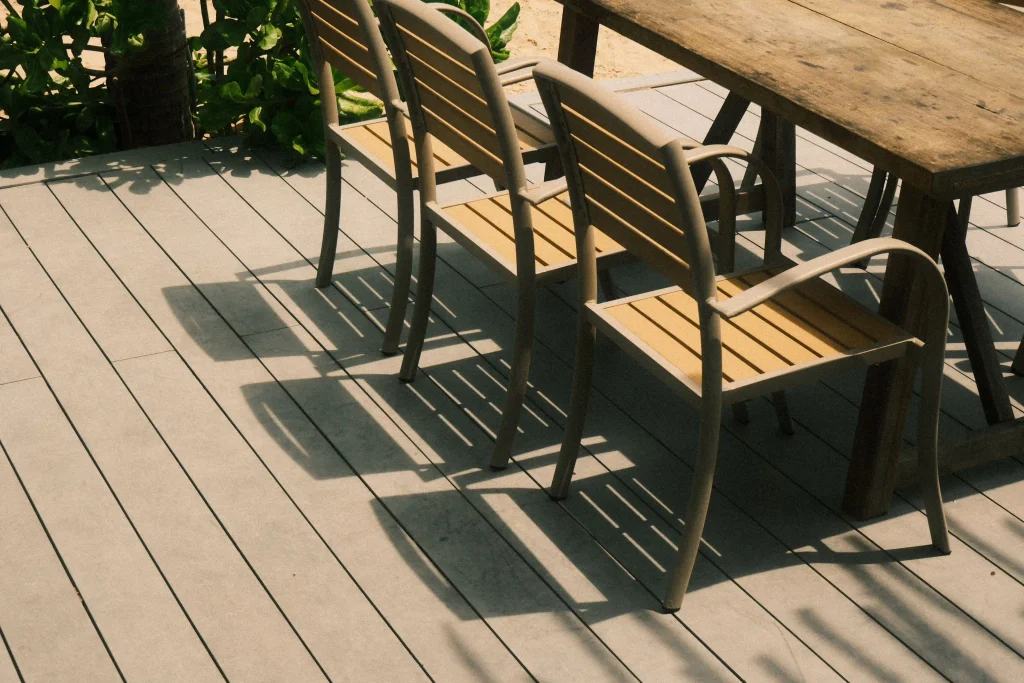
Appearance is subjective, but this is one area where modern composite decking and PVC decking have both improved considerably.
High-quality composite boards can feature realistic grain patterns and multi-tonal colors designed to replicate natural wood.
PVC products can also have realistic wood-inspired finishes, although some homeowners still prefer the feel and appearance of composite materials.
If creating a natural-looking outdoor space is important to you, look at actual samples rather than making your decision from photographs.
Pay attention to:
- Color variation
- Grain patterns
- Board texture
- Finish
- Lighting
- How the decking coordinates with your home’s exterior
- How the material looks alongside your chosen railing
DeckGuru’s composite deck railing guide can also help when you’re planning the railing and decking together.
Composite vs. PVC Decking: Which Costs More?
In many cases, PVC decking has a higher upfront price than composite decking, although pricing varies considerably by product line, manufacturer, location, deck size, and installation requirements.
Composite decking is often considered the middle ground between traditional wood and premium synthetic decking.
However, don’t make a decision based solely on the initial purchase price.
When evaluating PVC vs composite decking, consider the total cost of ownership.
That includes:
- Material costs
- Installation
- Fasteners and accessories
- Railings
- Maintenance
- Cleaning
- Repairs
- Expected service life
A less expensive material may require more maintenance, while a more expensive material may offer longer service life or lower ongoing costs.
The best choice is the material that provides the combination of performance, appearance, maintenance, and value that fits your priorities.
Is Composite or PVC Better for Northern Virginia?
For homeowners in Northern Virginia, both composite decking and PVC decking can be excellent choices.
Your deck needs to handle changing weather conditions throughout the year, including periods of rain, humidity, heat, and freezing temperatures.
Moisture resistance is particularly important because prolonged exposure to water can contribute to deterioration in materials that aren’t designed for outdoor conditions.
Composite decking with an appropriate protective shell can provide excellent moisture resistance. PVC is also naturally resistant to moisture because it is entirely synthetic.
That doesn’t mean either material can simply be installed and forgotten.
The structure underneath the decking still needs proper drainage, ventilation, and maintenance.
DeckGuru works throughout Northern Virginia, including Alexandria, Ashburn, Leesburg, Reston, and surrounding communities.
Can You Upgrade an Existing Wood Deck With Composite or PVC?
One of the biggest advantages of choosing manufactured decking is that you may not need to completely rebuild your deck.
If the existing framing is structurally sound and meets the requirements for the new decking system, it may be possible to remove the old deck boards and install new composite decking over the existing structure.
If the underlying framing has significant rot or structural deterioration, however, a more extensive replacement may be necessary.
DeckGuru’s deck replacement services explain some of the warning signs homeowners should watch for, including rotting wood, damaged posts, deteriorating ledger boards, and loose railings.
Composite vs. PVC Decking: Which Is Better for Your Home?
So, composite vs PVC decking—which is better?
The answer depends on what matters most to you.
Choose Composite Decking If You Want:
- A balance of cost and performance
- A realistic wood appearance
- Many color and design choices
- Low maintenance
- Excellent durability
- A proven option for residential decks
- A material that pairs well with composite railings
Composite is often the better all-around choice for homeowners who want low maintenance without moving into the highest-priced decking category.
DeckGuru’s experience with Trex composite decking makes it a particularly strong option for homeowners who want to upgrade an existing wood deck.
Choose PVC Decking If You Want:
- Maximum moisture resistance
- An entirely synthetic decking material
- Very low maintenance
- Lightweight boards
- Long-term performance
- A premium manufactured decking option
PVC can be particularly appealing when water exposure is a major concern or when a homeowner prioritizes a fully synthetic material.
Ultimately, there is no universal winner in the composite decking vs PVC comparison. The best material depends on your property, budget, design preferences, and long-term goals.
Other Factors to Consider Before Choosing Decking
The decking boards aren’t the only decision you’ll need to make.
Consider the complete outdoor space.
Deck Railing
Your railing can dramatically change the finished appearance of the deck.
DeckGuru offers a variety of railing materials and designs, including composite and aluminum options. Read more about cable vs. composite vs. aluminum deck railings when comparing different railing styles.
Deck Size and Layout
The size and shape of your deck will affect material requirements and project costs.
A simple rectangular deck will generally have different installation considerations than a multi-level deck with stairs, built-in seating, or unusual angles.
DeckGuru’s deck size guide can help you think through how much space you’ll need for furniture, entertaining, cooking, and everyday use.
Maintenance
Think about how much time you actually want to spend maintaining your outdoor space.
If your ideal weekend involves enjoying your deck rather than sanding and staining it, low-maintenance decking may be worth the investment.
Existing Structure
If you’re replacing an existing wood deck, don’t focus exclusively on the new boards.
The framing underneath should be evaluated to make sure it is structurally sound and appropriate for the new decking system.
Create an Outdoor Space You’ll Love
Choosing the right decking material is an important decision, but your deck should ultimately be designed around the way you live. Whether you prefer the natural-inspired look of composite decking or the moisture resistance and low maintenance of PVC, DeckGuru can help you weigh your options and determine what makes sense for your home, budget, and long-term goals.
Our experienced team specializes in restoring and upgrading existing decks, helping homeowners get more value from the structures they already have whenever possible.
Don’t settle for a deck that looks past its prime, contact DeckGuru or call 866-814-8188 today to schedule an estimate and start planning an outdoor space you’re excited to use.
Composite vs. PVC Decking FAQs
Is PVC decking better than composite decking?
Not necessarily. PVC decking offers excellent moisture resistance and low maintenance, while composite decking can provide a realistic wood appearance, durability, and generally lower upfront costs. The best option depends on your priorities.
Is composite decking more affordable than PVC?
Composite decking is often less expensive upfront than premium PVC decking, although prices vary by product, manufacturer, deck design, and installation. Compare the complete project cost rather than only the price per board.
Does PVC decking get hotter than composite decking?
It can. Surface temperature depends on the product’s color, composition, location, sunlight, and other environmental factors. Darker decking of many types can become hot when exposed to direct sunlight. Ask the manufacturer for product-specific information if heat is a major concern.
Which is more waterproof, composite or PVC decking?
PVC is completely synthetic and does not contain wood fibers, making it highly resistant to water absorption. Capped composite decking can also provide excellent moisture resistance. Product construction matters, so review the manufacturer’s specifications before choosing.
Does composite decking require sealing?
Generally, modern composite decking does not require the routine staining and sealing associated with traditional wood decking. However, maintenance requirements vary by manufacturer and product, so follow the care instructions for your specific decking.
Can PVC decking be installed over an existing deck?
Possibly, but the existing framing needs to be evaluated first. The structure must be sound and meet the requirements of the new decking system. A professional inspection can determine whether an existing deck is suitable for an upgrade.
How long does composite decking last?
The expected lifespan varies by product and manufacturer. Many modern composite decking systems are designed to last for decades, and warranties can vary significantly between product lines. Always review the specific product warranty rather than relying on a general lifespan estimate.
Is composite decking worth the money?
For many homeowners, yes. Composite decking generally costs more upfront than basic wood decking, but it requires significantly less maintenance and can provide long-term durability. The value depends on how long you plan to own the home and how much you value reduced maintenance.